

Introduction:
The greatest obstacle to organizing Sudanese society into a cohesive force capable of resisting the UAE’s terrorist project in Sudan is the continued wavering of the grassroots forces of the December Revolution in defining their position toward the national army.
As a result, the Islamic movement and the broader conservative current surrounding it have become the principal organized social force supporting the army—not because they represent the totality of Sudanese society, but because they are organized and decisive.
This reality has produced several serious problems. The most dangerous among them is the instinctive tendency, among Islamists, to use the war as a platform for settling scores with the December Revolution, which they simplistically believe was directed solely against them. This hostility toward the December Revolution intensifies the rift between the Sudanese army and revolutionary forces and weakens Sudanese society as a whole at a moment of existential foreign assault.
Another major challenge is that Islamist forces, generally speaking, are politically exhausted, aging, and burdened by heavy regional and international baggage. While none of this negates their legitimacy as Sudanese actors, it makes the question of building a broader national alliance both necessary and justified.
What, then, was the December Revolution?
For younger generations—and for contemporaries whose memories have been blurred by time—an answer is required.
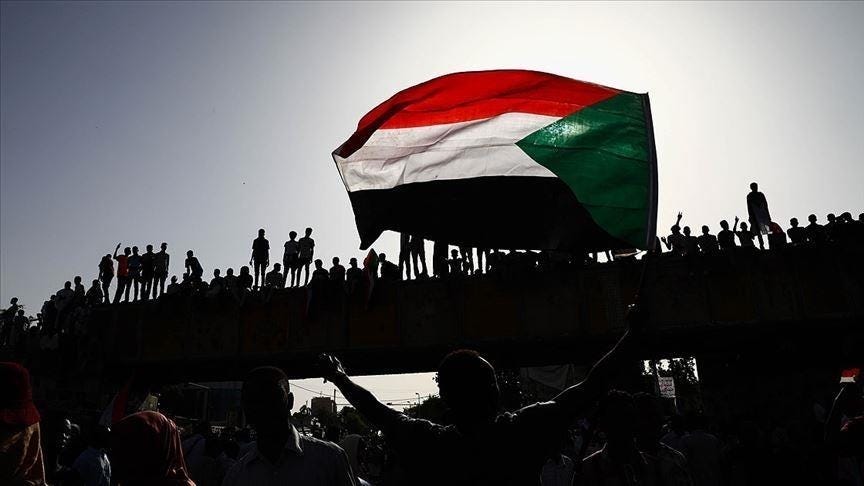
The December Revolution erupted in 2018 through protests against rising prices, within a broader popular struggle that had persisted since the failure of the Naivasha Agreement (2005–2011) to deliver a genuine democratic transition. That struggle had manifested in multiple waves of mass protest, most notably in September 2013, when demonstrations were brutally suppressed by the Rapid Support Forces, which had only recently been brought into Khartoum.
December 2018 was an uprising against a totalitarian regime steeped in terror and repression, led by Omar al-Bashir. Sudanese society, across ideological lines, had reached a consensus that the regime had to fall. This included not only Islamist factions that had broken with the regime—such as the Popular Congress Party led by Hassan al-Turabi, the Reform Now movement led by Ghazi Salah al-Din, and other renewal and reformed Islamist factions—but also figures from within the regime itself who attempted the so‑called “National Dialogue” in 2014-1015 a weak attempt to replicate the Naivasha model.
In this context, December emerged as a broad Sudanese revolution involving all political tendencies, including Islamists. One of the clearest symbols of this inclusivity was the martyr Ahmed al‑Khair, a member of an Islamist party who became a leading symbol of the revolutionary spirit. This was in addition to the significant participation and sacrifices of young Islamist leaders during the six months of uprising, most notably Hisham al‑Shuwani and others who endured well‑documented persecution.
At the same time, the revolution was undeniably directed against an Islamist ruling system. This produced grassroots currents that were deeply hostile to Islamists, a contradiction that could have been resolved through national dialogue. Instead, the revolutionary process was derailed when trade unions and resistance committees—under the leadership of the Sudanese Professionals Association—aligned with political forces whose defining feature was hostility toward Islamists, pushing the revolution into an indiscriminate confrontation.
The Forces of Freedom and Change: Political Opportunism
Under the leadership of the Sudanese Professionals Association—a coalition of doctors’, lawyers’, and teachers’ unions—mass protests were organized for months, culminating in the Khartoum sit‑in outside army headquarters, demanding El-Bashir’s removal.
Meanwhile, opposition political parties maneuvered to dominate the revolution, culminating in the January 2019 “Declaration of Freedom and Change,” which became the theoretical platform for a broader alliance later known as the Forces of Freedom and Change. The coalition comprised the trade unions (the Sudanese Professionals Association) and opposition political parties, which were largely aligned with foreign powers, including the UAE. This strategic error was widely opposed—not only by Islamist and conservative revolutionary factions, but also by activists on the ground—due to deep public mistrust of Sudan’s political class.
That mistrust proved justified.
The claim that the December Revolution forces = the Forces of Freedom and Change has two logical sources: the Forces of Freedom and Change political parties themselves, seeking legitimacy, and the remnants of the former regime, seeking to discredit the revolution by associating it with a widely despised political elite.
In reality, the Forces of Freedom and Change, eventually led by former president Abdalla Hamdok, opportunistically rode on the back of the December Revolution, owing to institutional weakness stemming from decades of political repression and youth disengagement from formal politics, making them the only viable force to fill a huge leadership vacuum.
The Rapid Support Forces: Killing revolutionaries from day one!
The relationship between the December Revolution and the Rapid Support Forces is one of irreconcilable contradiction. While the Bashir regime, at that time supported by Islamists, legalized the RSF through parliament in 2017 after formalizing it in 2013, those same forces massacred pro-democracy protesters in September 2013 and again during the December Revolution’s sit‑in massacre—crimes documented in widely circulated videos:
RSF's terror against resistance committees is well known. In December 2020, RSF‑linked forces abducted and tortured resistance activist Bahaa El‑Din Nouri to death. Later investigations confirmed the perpetrators belonged to RSF intelligence units. His crime was resisting the UAE‑backed empowerment of the militia.
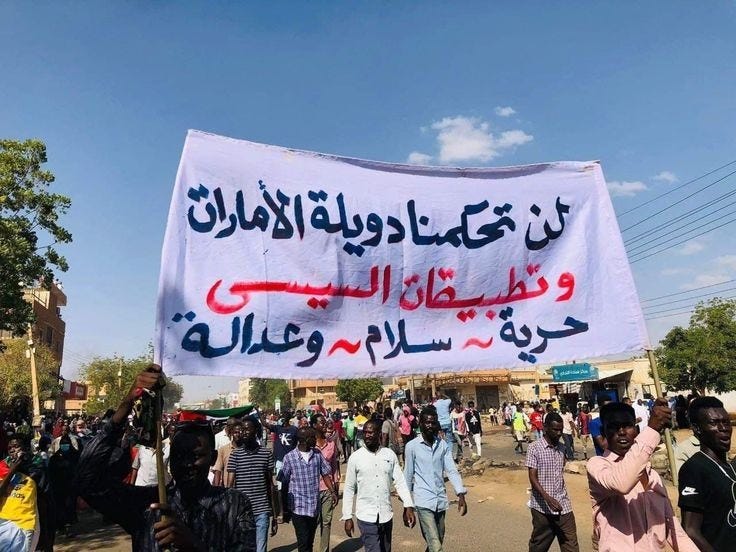
The December Revolution, like all genuine national revolutions, stood fundamentally against the new Emirati colonial project and its local agents, making the contradiction with the RSF the primary national contradiction.
The December Revolution and the Current War
The current war erupted on the ruins of the December Revolution. Structural weaknesses, geopolitical pressures—including the UAE colonial project and the Trump administration’s ambiguous Sudan policy—and unresolved philosophical questions about democracy and national unity all paved the way to catastrophe.
War does not allow neutrality. One must choose between the RSF terrorist militia and the Sudanese army. Faced with this reality, revolutionary forces hesitated, thereby creating space for the false neutrality promoted by the Forces of Freedom and Change and echoed by radical left factions—positions best described as politically cowardly.
Yet a future remains possible. Many December revolutionaries have consciously aligned with the army—not in pursuit of military authoritarianism, but in recognition that this is a war of foreign colonial aggression, utilizing a genocidal terrorist militia (the RSF). Intellectuals such as Abdullahi Ali Ibrahim and figures like Mohamed Jalal Hashim embody this stance.
This alignment must deepen through the spiritual and historical platform of the December Revolution itself—not through the regressive ideology of military rule. We call for a conscious rupture within the pro‑army camp: a rupture in language, vision, and political horizon, without abandoning realistic alliances to defeat the RSF militia.
Only through rebuilding grassroots democratic organizations inside and outside Sudan—following the December experience—can Sudan prepare for the post‑war future. Without a national democratic project, this will not be the last war… But it might be the last war with just two armies participating in it!
I will end with some of the December Revolution’s popular slogans:
Freedom, peace, and justice. The revolution is the people’s choice.
No militia shall rule a state.
The army to the barracks. The Janjaweed (RSF) must be dismantled.
Glory to all martyrs—those of peaceful protest and those forced into a just war.